


If you have any questions, please contact our online customer service staff immediately
 Click:13
Edit: CHUANGHE HOIST
 Time:2026-10-20 11:06:48
This blog takes lifting hooks as core subject, introducing functions, mainstream types, key safety components, material standards and application scenarios of industrial & construction‑grade lifting hooks. It provides reference parameter table for different working‑load‑level hooks, lists pre‑use inspection checkpoints and common wrong operation reminders. It helps procurement engineers and site managers select proper CHHOIST lifting hooks according to project load, environment and safety certification requirements, with in‑text internal link pointing to CHHOIST lifting‑hooks product detail page.

| Hook Type | Working Load Limit(WLL) | Main Material | Key Feature | Typical Application |
|---|---|---|---|---|
| Eye Lifting Hook with Safety Latch | 2‑15 Ton | Drop‑forged Alloy Steel | Fixed eye‑shaped connection, safety latch | Crane, hoist general‑purpose lifting |
| Swivel Lifting Hook | 3‑20 Ton | Drop‑forged Alloy Steel | 360‑degree swivel rotation, anti‑twist | Multi‑direction material hoisting, construction site |
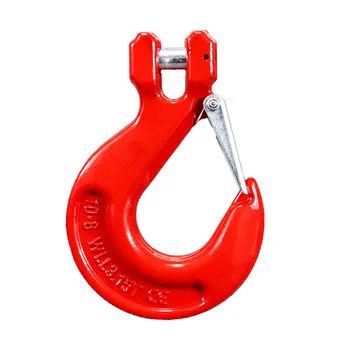
| Clevis Lifting Hook | 1‑10 Ton | Drop‑forged Alloy Steel | Clevis connection for chain sling | Chain rigging assembly, warehouse handling |
| Heavy‑Duty Forged Hook | 10‑30 Ton | High‑strength Alloy Steel | Thickened forging, high impact resistance | Heavy‑industry, ship‑building, steel‑structure project |
Lifting hooks belong to critical rigging hardware widely deployed across industrial manufacturing, building construction, warehouse logistics and ship‑building sectors. As the connecting point between hoist/crane and slings or chains, the quality of lifting hooks directly decides overall lifting safety. Many purchasers focus merely on load tonnage while ignoring material, safety latch function and certification marks, which may bring hidden danger for on‑site heavy‑load operation. This buying guide sorts out core knowledge to help you pick suitable lifting hooks for your industrial or construction projects.
First, you need to distinguish common lifting hook categories. Eye lifting hook is the most universal type, equipped with fixed eye ring for shackle or wire‑rope connection, mostly fitted with safety latch for general‑purpose hoisting work. Swivel lifting hook supports 360‑degree free rotation, effectively avoiding chain or wire‑rope twisting during lifting, popular on complex construction sites. Clevis lifting hook adopts clevis structure, designed specially for matching chain slings. For ultra‑heavy‑duty scenarios such as steel‑structure assembly and ship‑building, users should select heavy‑duty forged lifting hooks with enhanced wall thickness and higher impact resistance.
Material determines hook durability and anti‑break performance. Qualified industrial lifting hooks are manufactured from drop‑forged alloy steel rather than ordinary cast steel. Cast hooks may produce invisible internal cracks under heavy impact and are strictly forbidden for critical lifting work. Surface anti‑corrosion treatments including powder coating or galvanization extend service life for outdoor construction environments with humidity and rust risk.
Safety latch is a non‑negotiable component for most lifting hooks. During lifting process, load swing and vibration may make slings slide out of hook opening; a well‑function safety latch locks hook opening and prevents accidental load dropping. You must check whether the latch springs back smoothly before each shift. Never use lifting hooks with damaged or removed safety latches just for temporary convenience.
Working Load Limit(WLL) marking cannot be overlooked. Every formal lifting hook should be clearly stamped with WLL tonnage mark. Operators are prohibited to overload lifting regardless of hook appearance. Besides load capacity, certification status matters greatly. For European and global export projects, CE‑certified lifting hooks meet international rigging safety standards and clear customs smoothly. Non‑certified low‑cost hooks will trigger safety risks and customs obstacles.
Daily pre‑use inspection routine is essential. Before every lifting task, inspect hooks for visible cracks, hook‑opening permanent deformation, local excessive wear. If wear depth exceeds 10% of original nominal size, the hook should be scrapped immediately. Welding repair for cracked lifting hooks is not allowed, because high‑temperature welding will destroy original forging material performance.
Project environment influences final selection. Indoor warehouse routine handling can adopt standard eye lifting hooks. Outdoor construction sites with frequent multi‑angle hoisting prefer swivel lifting hooks. Heavy‑tonnage steel‑structure projects should upgrade to heavy‑duty forged series. CHHOIST supplies full‑range professional lifting hooks for industrial and construction use with complete certification support. Visit CHHOIST lifting hooks product page to view full specifications and send your project‑based inquiry.
Lifting hooks are core rigging hardware for connecting cranes, hoists and slings, widely used for material handling in construction, manufacturing, warehouse logistics and ship‑building heavy‑load lifting jobs.
Safety latches prevent slings or chains from slipping out of hook opening under vibration or swing, greatly reducing falling‑load risks during lifting operations.
Most industrial‑grade lifting hooks adopt drop‑forged alloy steel, delivering high tensile strength, impact resistance and long service life under heavy‑load working conditions.
Check for cracks, excessive wear, deformation of hook opening, safety latch function and confirm working load limit matches actual lifting weight. Do not use damaged hooks.
Reliable lifting hooks shall pass CE certification, marked with clear WLL(Working Load Limit), comply with international rigging safety standards.
This blog takes lifting hooks as core subject, introducing functions, mainstream types, key safety components, material standards and application scenarios of industrial & construction‑grade lifting hooks. It provides reference parameter table for different working‑load‑level hooks, lists pre‑use inspection checkpoints and common wrong operation reminders.
2026-10-20View More →
This article targets warehouse maintenance engineers and facility managers. It establishes daily, weekly and quarterly maintenance checklists for electric stacker crane, covering rail, wheel, telescopic fork, motor, sensor, cable and safety limit switches. It lists common faults: positioning deviation, fork stuck, abnormal noise, communication failure, and corresponding troubleshooting steps. It explains how regular maintenance reduces downtime and extends stacker crane service life, also introducing CHHOIST global after-sales and spare parts service.
2026-10-16View More →
This is a buyer-focused purchasing guide. It lists all critical technical parameters for selecting an electric stacker crane: load capacity, lifting height, travel speed, positioning accuracy, pallet size and environment conditions (cold storage, dust). It analyzes investment cost composition, return on investment, and how to match stacker crane with racking and WMS. It helps warehouse project buyers compare suppliers and avoid common selection mistakes, strong commercial conversion intent.
2026-10-08View More →


 Tel:
+8613653129869
 Whatsapp:
+8613653129869
 Email:
chuanghehoist@gmail.com
 Address:Donglu Village, Donglu Township, Qingyuan District, Baoding City, Hebei Province

 English
 Français
 Español


 Email
 +8613653129869
 +8613653129869

 Home
 Whatsapp
 chuanghehoist@gmail.com